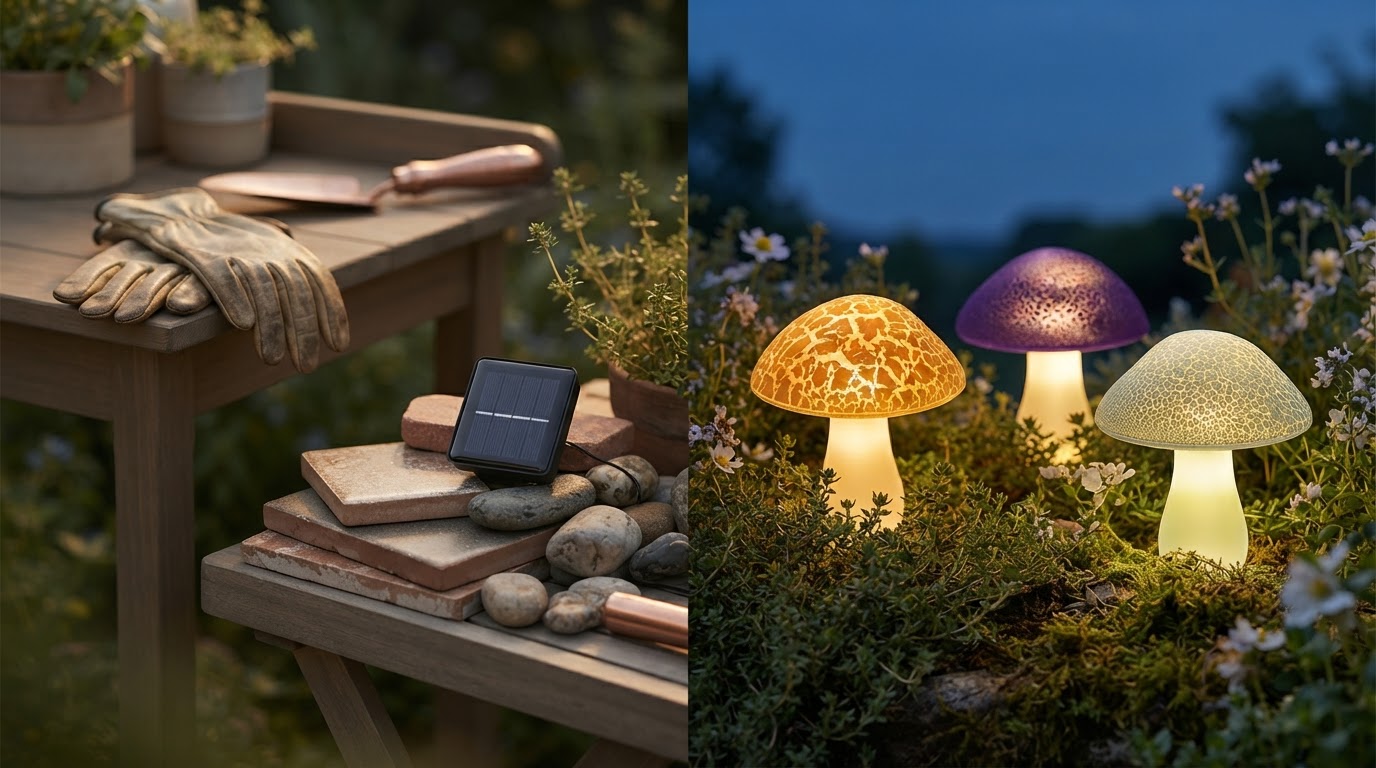
Selecting Solar Mushroom Lights for Sustainable Landscaping
 Maya ChenContributing Editor
September 15, 2026 — The shift toward low-impact landscape design has accelerated the adoption of Solar Mushroom Lights as a primary alternative to hardwired low-voltage systems. While many homeowners view these as purely aesthetic additions, the shift represents a broader movement toward decentralized energy in residential gardening.
The conventional wisdom says that solar-powered accents are inherently inferior to AC-powered systems in terms of reliability and output. However, data from the International Dark-Sky Association suggests that over-lighting residential spaces contributes significantly to light pollution, making the targeted, lower-lumen output of solar fixtures a more responsible choice for nocturnal ecosystems. By focusing light downward and utilizing specific kelvin ranges, these fixtures minimize skyglow while providing necessary path illumination.
The 5 Technical Benchmarks
Here's the part nobody talks about: the efficacy of outdoor mushroom garden lights is dictated entirely by the relationship between the photovoltaic conversion rate and the milliampere-hour (mAh) capacity of the internal cell. Most consumer-grade units utilize monocrystalline silicon panels, which offer a conversion efficiency of approximately 15-20%. When paired with a 600mAh Ni-MH battery, a standard Solar Mushroom Light requires roughly 6 to 8 hours of direct irradiance to provide a consistent 8-hour discharge cycle. If the garden layout places these units under a dense canopy, the discharge-to-charge ratio fails, leading to premature battery degradation. For those managing limited space, understanding mini mushroom solar lights for planters is essential for maintaining proper solar exposure. Furthermore, the IP (Ingress Protection) rating is the only metric that matters for longevity; an IP65 rating is the baseline for resisting the dust and low-pressure water jets common in active garden environments. If you are concerned about placement in low-light areas, you should review how solar mushroom lights perform in shaded conditions before finalizing a layout. The aesthetic choice between cool and warm tones also impacts perceived brightness, as detailed in our analysis of warm white solar mushroom string lights. Finally, when scaling these systems for entertainment areas, integrating solar mushroom string lights for patio use requires a different calculation of lead-wire length and panel positioning.
Expert tip: Avoid placing solar sensors directly beneath existing streetlights or powerful porch lamps, as the ambient light will often exceed the photodiode's threshold, preventing the mushroom lights from activating at dusk.
I’ll change my mind when solid-state battery technology becomes the standard for entry-level garden accents, but until then, success depends entirely on panel placement and moisture sealing.