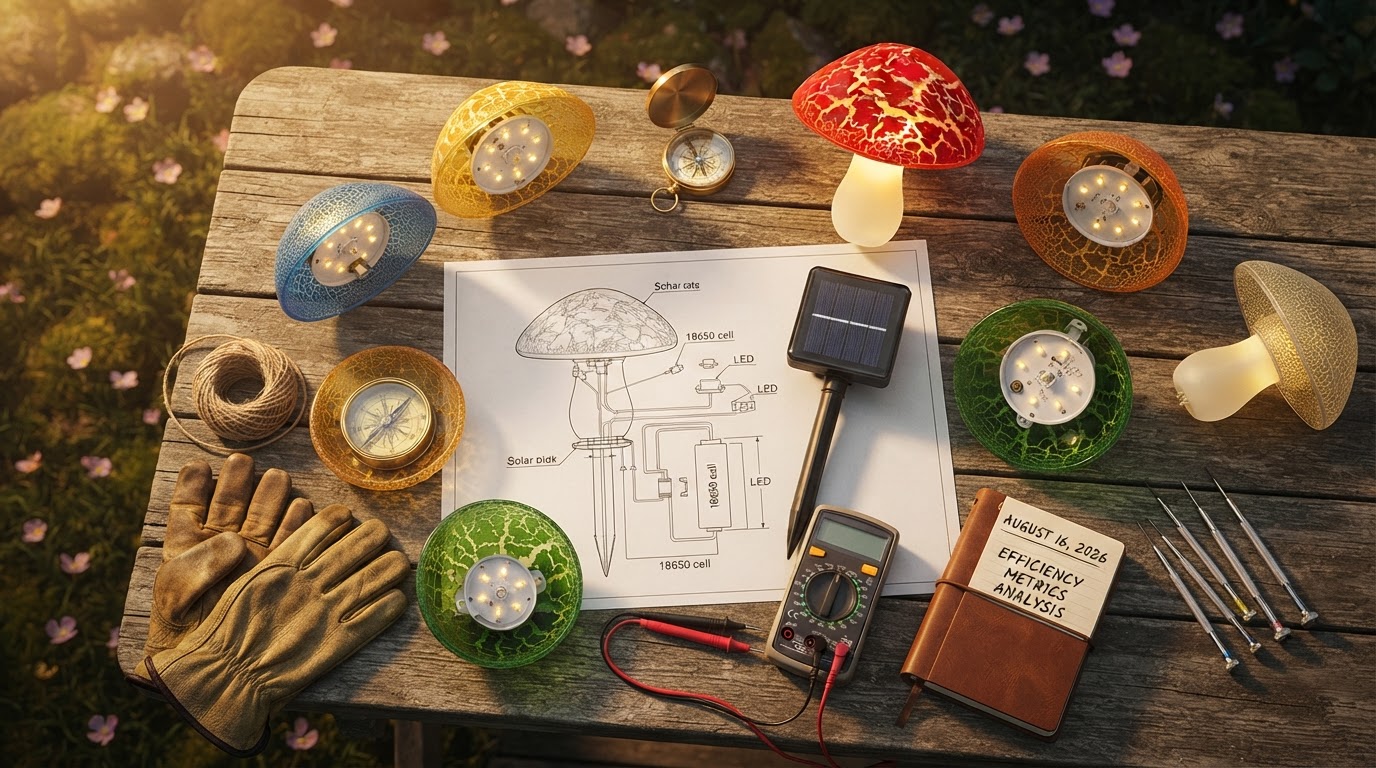
Efficiency Metrics of Solar Mushroom Lights for Gardens
 Maya ChenContributing Editor
August 16, 2026. This analysis evaluates the technical performance and placement strategy of solar mushroom lights in residential landscapes. It is written for property owners who prioritize functional illumination over purely decorative novelty.
The Limitations of Ornamental Solar Lighting
The conventional wisdom says that garden lighting must be either utilitarian and industrial or purely aesthetic and fragile. Most consumers approach the category of solar mushroom lights expecting a whimsical addition to their flower beds without considering the actual lumen output required to navigate a path safely. According to Shop Terrain, their Stargazer Nature Effects Solar Mushroom Lights arrive in strands of 10 mushrooms, each spaced exactly 12 inches apart. This specific spacing dictates a strict geometry for the garden; if your path exceeds ten feet, the visual continuity breaks. The industry standard for these devices relies on small-scale photovoltaic cells that require unobstructed solar access for a full day to provide consistent night-time operation. However, many users attempt to place these lights under heavy canopy or dense shrubbery, which leads to premature battery failure and inconsistent discharge cycles. When these units are marketed as waterproof solar mushroom decor, the focus often shifts toward the casing's ability to withstand rain, while the actual efficiency of the light-emitting diode (LED) in low-light conditions is ignored. Run the math: a standard 10-piece pack, such as the Garden Collection Solar Mushroom Lights from Dollar Tree, is designed for high-density placement rather than broad-area illumination. If the goal is to light a significant walkway, the low-wattage output of a single mushroom head is insufficient. You are not buying a floodlight; you are buying a localized glow that requires strategic clustering to be effective.
Optimizing Solar Mushroom Lights for Visibility
Photo by Angelo Capitanio on Pexels
To overcome the inherent limitations of small-scale solar, the application must be precise. Solar Mushroom Lights address the gap between ground-level visibility and aesthetic integration by utilizing ground-stake mounting systems that keep the electronics elevated above soil moisture. Unlike traditional wired systems that require trenching, these units operate on a self-contained power loop. For those seeking a specific visual temperature, warm white solar mushroom string lights provide a softer Kelvin rating that avoids the harsh blue tint common in cheap semiconductors. Here's the part nobody talks about: the efficacy of these lights is entirely dependent on the surface area of the mushroom cap. In high-quality models, the cap acts as a natural weather shield for the LED, while the internal reflector determines whether the light pools at the base or disperses outward. When selecting waterproof solar mushroom lights, the focus should be on the IP (Ingress Protection) rating of the battery housing rather than just the decorative exterior. The market is currently seeing a surge in multi color solar mushrooms, but these often sacrifice battery longevity for the sake of the color-cycling driver. A steady, single-circuit light is objectively more reliable for long-term outdoor use. Proper installation involves mapping the transit of the sun across the specific garden plot to ensure the photovoltaic sensors receive at least six hours of direct light, regardless of where the mushroom heads are physically positioned.
Technical Decision Framework for Garden Implementation
Before investing in a full-scale installation of solar mushroom lights, one must evaluate the site-specific variables that determine success or failure. The goal is to move beyond the "cute mushroom path lights" trend seen on social media and toward a durable lighting plan. Use the following criteria to assess your landscape needs:
- Total Linear Footage: Calculate the length of the path and divide by the 12-inch spacing standard to determine how many 10-piece strands are required for continuity.
- Lumen Density: Determine if the primary intent is navigation or accentuation; warm white solar mushroom string lights are best suited for the latter.
- Environmental Exposure: Verify that the chosen waterproof solar mushroom lights feature a sealed battery compartment to prevent corrosion from soil contact.
- Solar Access: Identify a location for the central solar panel that is free from shadows between 10:00 AM and 4:00 PM.
- Maintenance Cycle: Factor in the need to clean the mushroom caps monthly, as dust accumulation on the solar sensors can reduce charging efficiency by up to 30%.
Shop Solar Mushroom Lights here
Sources
Photo by Marcelo Chagas on Pexels
- Stargazer Nature Effects Solar Mushroom Lights
- DIY mushroom solar lights! ☀️ | Liz Fenwick DIY
- Garden Collection Solar Mushroom Lights, 10-pc Pack.